Learn how to evaluate an OBD II diagnostic cable manufacturer based on signal integrity, material durability, and SAE J1962 compliance for professional automotive testing equipment.
The precision of modern vehicle diagnostics depends on more than just software; it relies on the physical integrity of the connection between the vehicle’s ECU and the testing hardware. For engineers and procurement managers developing automotive scanners, telematics devices, or fleet management systems, selecting the right OBD II diagnostic cable manufacturer is a critical decision that impacts product reliability and brand reputation.
A high-quality diagnostic cable must maintain signal stability under harsh garage conditions, resist chemical exposure, and withstand thousands of mating cycles. This guide examines the technical requirements and manufacturing standards essential for professional-grade OBD II assemblies.
Understanding the Technical Architecture of OBD II Cables
At its core, an OBD II cable follows the SAE J1962 standard, which defines the physical configuration of the 16-pin connector. However, "standard-compliant" does not always equate to "industrial-grade."
Professional automotive testing equipment requires specific internal architectures:
- Twisted Pair Wiring: Critical for CAN bus communication (Pins 6 and 14) to minimize electromagnetic interference (EMI).
- Shielding Layers: High-end manufacturers utilize aluminum foil and tinned copper braiding to protect data packets from engine bay noise.
- Gauge Selection: While standard 26 AWG is common, 24 AWG or 22 AWG wiring is often preferred for longer cable runs to prevent voltage drops.
Material Science in Automotive Environments
The environment in which a diagnostic cable operates is unforgiving. A reliable manufacturer must offer material options tailored to specific use cases.
| Feature |
Standard PVC |
Premium TPU (Thermoplastic Polyurethane) |
| Flexibility |
Moderate; stiffens in cold weather |
Excellent; remains flexible at -40°C |
| Oil Resistance |
Low to Moderate |
High (Resistance to gasoline, grease, and solvents) |
| Abrasion Resistance |
Standard |
Superior (Ideal for heavy-duty workshop use) |
| Common Use Case |
Consumer code readers |
Professional workshop scanners & Fleet telematics |
For most professional diagnostic tools, TPU jacketing is the industry benchmark. It provides the tactile "soft-touch" feel while ensuring the internal conductors are not compromised by being stepped on or crushed by shop equipment.
Why Customization is Essential for OEM Projects
Off-the-shelf OBD II cables rarely meet the needs of specialized testing equipment. When partnering with an OBD II diagnostic cable manufacturer, look for comprehensive customization capabilities, including:
- Pinout Mapping: Not every application requires all 16 pins. Custom pinouts reduce cable diameter and cost while improving flexibility for hidden installations (e.g., GPS trackers).
- Overmolding Designs: Custom strain reliefs and housing shapes are necessary for ergonomic handheld tools or space-constrained vehicle dashboards.
- Integrated Electronics: High-tier manufacturers can integrate PCBs, resistors, or LED indicators directly into the connector housing.
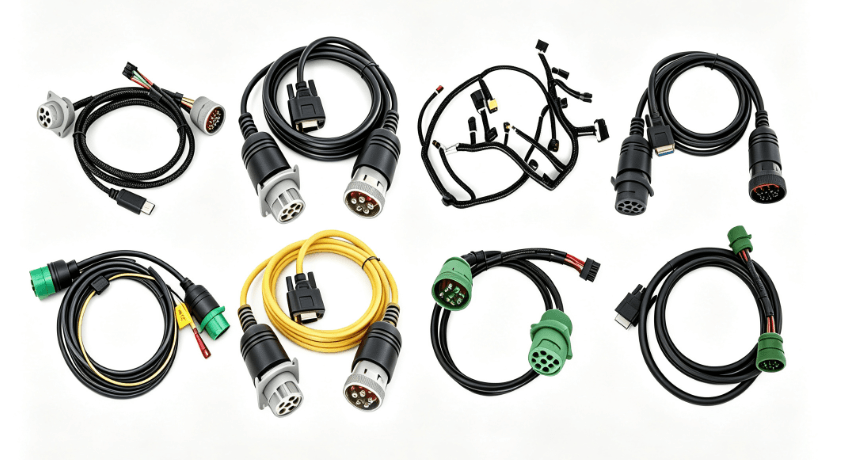
- Connector Hybridization: Converting OBD II to heavy-duty J1939 (Type 1 or Type 2) or J1708 for commercial vehicle diagnostic cross-compatibility.
Manufacturing Process and Quality Assurance
A reputable manufacturer utilizes a multi-step quality control process to ensure zero-defect delivery. In the automotive sector, failure at the cable level can lead to expensive troubleshooting and product returns.
The manufacturing workflow should include:
- Automated Crimping: Ensures consistent tension and contact resistance across all pins.
- Internal Injection Molding: Before the final decorative overmold, internal molding secures the wires in place, preventing shorts caused by mechanical vibration.
- Continuity and High-Voltage Testing: Every cable must undergo automated testing for open circuits, short circuits, and insulation resistance.
- Environmental Testing: High-quality partners conduct salt spray tests, thermal cycling, and plug/unplug durability testing in their labs.
Evaluating Your Manufacturing Partner: The Soar Cable Advantage
When sourcing components for automotive testing equipment, the manufacturer's infrastructure matters as much as their price list.
Soar Cable stands out in the industry by specializing in high-performance OBD II and heavy-duty vehicle cables. Their manufacturing capabilities cover the entire spectrum of diagnostic connectivity, from standard OBD2 male-to-female extensions to complex Y-splitters and custom-engineered J1939 assemblies.
For B2B buyers, Soar Cable provides the technical documentation and material certifications (such as RoHS and REACH compliance) required for global market entry. Their focus on precision overmolding and signal integrity makes them a preferred partner for OEM projects where reliability is non-negotiable.
Key Considerations for Procurement Managers
Before issuing an RFQ (Request for Quote), ensure your requirements cover these critical metrics:
- MOQ (Minimum Order Quantity): Does the manufacturer support small-batch prototyping before moving to mass production?
- Lead Times: Automotive project timelines are often tight. Confirm the manufacturer’s capacity to scale production quickly.
- Tooling Ownership: For custom overmolds, clarify who owns the injection molds and how maintenance is handled.
- Compliance: Verify that the factory operates under ISO 9001 or IATF 16949 quality management systems to ensure consistent automotive-grade output.
FAQ
What is the difference between an OBD II cable and a J1939 cable?
While both are used for diagnostics, OBD II (SAE J1962) is the standard for passenger vehicles, featuring a 16-pin trapezoidal connector. J1939 is the standard for heavy-duty commercial vehicles (trucks, buses), typically using a round 9-pin Deutsch connector.
Can a manufacturer provide custom-length OBD II cables?
Yes. Custom lengths are common for fleet management (short cables for hidden installs) and garage diagnostics (extra-long 3-5 meter cables for mobility around the vehicle).
Why do some OBD II cables feel "stiff" or "cheap"?
Stiffness is usually a result of using low-grade PVC jacketing or a high percentage of recycled plastics. Professional-grade cables use virgin TPU or high-flex PVC to ensure the cable doesn't retain "memory" loops or crack over time.
Are all 16 pins always wired in a diagnostic cable?
No. Most applications only require specific pins for power, ground, and CAN High/Low communication. Custom-wiring only the necessary pins makes the cable thinner, more flexible, and more cost-effective.
Reference Sources


