Learn how to specify SOAR custom heavy duty cable assemblies for extreme industrial conditions. This guide covers material selection, IP ratings, and mechanical durability for engineers and OEM buyers.
The cost of a single cable failure in an automated production line often exceeds the price of the cable assembly by a factor of ten thousand. When a standard interconnect fails under the stress of chemical exposure, extreme temperatures, or millions of flex cycles, it results in unplanned downtime, lost revenue, and safety risks.
For engineers and procurement managers, "heavy duty" is not a marketing term—it is a performance requirement. SOAR Custom Heavy Duty Cable Assemblies are engineered to bridge the gap between standard off-the-shelf components and the rigorous demands of modern industrial infrastructure.
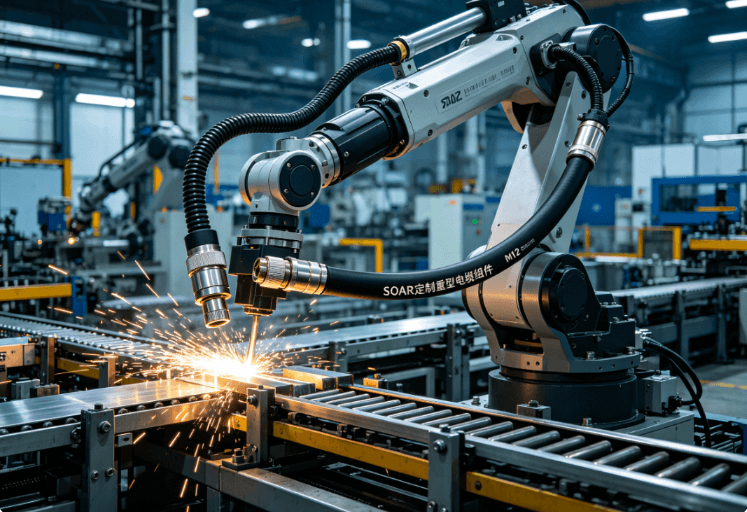
What Defines a "Heavy Duty" Cable Assembly?
A heavy-duty cable assembly is defined by its ability to maintain signal integrity and mechanical wholeness while subjected to environmental or physical stressors that would destroy commercial-grade electronics.
In the industrial sector, "heavy duty" typically encompasses four pillars of resilience:
- Mechanical Strength: Resistance to abrasion, crushing, and high-tensile loads.
- Environmental Shielding: Protection against moisture, UV radiation, and extreme thermal fluctuations (ranging from -40°C to +105°C or higher).
- Chemical Resistance: Immunity to oils, coolants, degreasers, and corrosive cleaning agents.
- Electromagnetic Compatibility (EMC): Superior shielding to prevent signal interference in "noisy" factory environments.
Material Selection: The Core of Industrial Durability
When specifying custom assemblies, the choice of jacketing and insulation material determines the lifespan of the interconnect. At SOAR, customization begins with matching the polymer to the application environment.
- Polyurethane (PUR): Often the first choice for "demanding environments." PUR is halogen-free, highly resistant to abrasion, and maintains flexibility at low temperatures. It is the gold standard for drag chain applications and robotics.
- Polyvinyl Chloride (PVC): While standard, industrial-grade PVC is formulated for better oil resistance and flame retardancy (UL 94V-0). It is cost-effective for fixed installations where chemical exposure is moderate.
- Thermoplastic Elastomer (TPE): Offers excellent flexibility and resistance to welding slag, making it ideal for automotive assembly lines and robotic welding cells.
Engineering for Dynamic vs. Static Stress
A common mistake in procurement is failing to distinguish between static and dynamic installations.
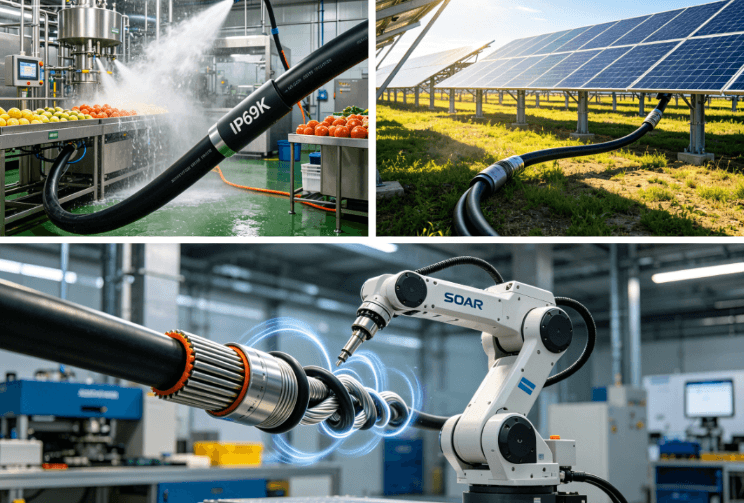
Static Applications (e.g., control cabinet internal wiring) require durability against heat and aging. Dynamic Applications (e.g., multi-axis industrial robots or CNC drag chains) require a focus on "flex life."
For dynamic environments, SOAR Custom Heavy Duty Cable Assemblies utilize specialized stranding techniques. Using finer copper wire strands increases the cable's bending radius capability and prevents "corkscrewing"—a common failure mode where the internal conductors twist and eventually break through the jacket.
| Feature |
Standard Cable |
SOAR Heavy Duty Custom Assembly |
| Jacket Material |
Generic PVC |
High-grade PUR / Reinforced TPE |
| Shielding |
Foil only |
Tinned copper braid (>85% coverage) + Foil |
| IP Rating |
IP20 / IP54 |
IP67 / IP68 / IP69K |
| Flex Cycles |
< 500,000 |
5 million to 20 million (Application dependent) |
| Temperature Range |
0°C to 60°C |
-40°C to +125°C (Custom options) |
Connector Integration: M-Series and Beyond
The cable is only as strong as its weakest link, which is almost always the termination point. For industrial automation, the integration of M-series connectors (M8, M12, M23) is standard.
However, a truly custom heavy-duty assembly goes beyond the standard pinout. It involves:
- Overmolding: Providing superior strain relief and moisture ingress protection compared to field-attachable connectors.
- Shielding Continuity: Ensuring the 360° braid is properly terminated to the connector shell to eliminate EMI "leaks."
- Gold-Plated Contacts: Preventing oxidation in high-humidity or corrosive environments to ensure low contact resistance over years of service.
Application Logic: Matching the Assembly to the Sector
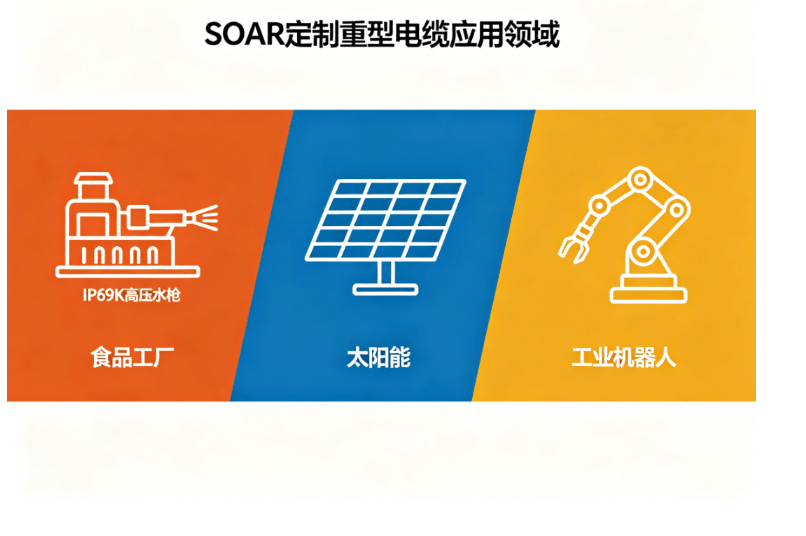
The definition of "demanding" changes based on the industry. A custom assembly designed for a food processing plant has different requirements than one designed for a solar farm.
1. Food and Beverage (Washdown Environments)
These cables require IP69K ratings, meaning they can withstand high-pressure, high-temperature washdowns. The materials must be FDA-compliant and resistant to aggressive caustic cleaning agents. ECOLAB certification is often a benchmark here.
2. Renewable Energy (Outdoor Exposure)
Cables used in solar trackers or wind turbines must be UV-stabilized and ozone-resistant. They face "weathering" rather than "wear." Without proper UV inhibitors in the jacket, the cable will crack and fail within 24 months of sun exposure.
3. Industrial Robotics (Torsional Stress)
In a 6-axis robot, the cable doesn't just bend; it twists. Custom assemblies for this sector require "Torsion-rated" jackets and internal spacers (like PTFE tapes) that allow the conductors to slide against each other without generating friction heat.
The SOAR Customization Workflow: From RFQ to Production
Navigating the transition from a technical requirement to a finished product requires a structured approach. When evaluating SOAR Custom Heavy Duty Cable Assemblies, the following technical parameters should be established during the design phase:
- Electrical Loads: Voltage rating and current carrying capacity (Ampacity), accounting for "de-rating" factors if cables are bundled.
- Signal Integrity: Requirements for Cat6a data speeds, Analog 4-20mA precision, or high-speed Servo feedback.
- Mechanical Constraints: Minimum bending radius (fixed vs. moving) and maximum pulling force.
- Compliance: Specific industry certifications such as UL/CSA, CE, RoHS, or REACH.
By focusing on these specifics, SOAR ensures that the final assembly is not just "heavy duty" in name, but "fit for purpose" in the most punishing environments on earth.
FAQ
Q1: What is the lead time for custom heavy duty cable assemblies?
Lead times typically vary based on material availability. For standard industrial connectors (like M12) and PUR jackets, prototypes can often be produced in 1–2 weeks, with mass production following after approval. Custom-engineered compound jackets may require longer lead times.
Q2: How do you test for "flex life" in drag chain cables?
We utilize specialized testing rigs that simulate the specific travel distance, acceleration, and bending radius of your application. Cables are often tested to 5 million, 10 million, or 20 million cycles depending on the grade of the assembly.
Q3: Can SOAR provide cable assemblies that are both oil-resistant and flame-retardant?
Yes. By using specific PUR or flame-retardant TPE formulations, we can meet UL 1581 (oil resistance) and UL 94V-0 (flame retardancy) standards simultaneously.
Q4: What is the minimum order quantity (MOQ) for a custom design?
MOQs are project-dependent. While custom-extruded cable runs may require higher minimums (e.g., 500–1000 meters), assemblies using stocked industrial-grade cables often have much lower MOQs to support OEM prototyping.
Q5: Are these assemblies compatible with major PLC and Servo brands?
Yes, SOAR customizes assemblies to be fully compatible with systems from Siemens, Rockwell Automation, Fanuc, and Beckhoff, ensuring connector keying and pinouts match OEM specifications exactly.
Reference Sources
- IEC 60529: Degrees of protection provided by enclosures (IP Code).
- UL 758: Standard for Appliance Wiring Material (AWM) used in industrial cables.
- ISO 9001:2015: Quality management systems for manufacturing. Link to ISO
- NEMA (National Electrical Manufacturers Association): Guidelines for industrial interconnects in harsh environments. Link to NEMA


