

2026-10-22
The reliability of a vehicle diagnostic system is only as strong as its weakest link. In professional automotive environments, that link is frequently the physical interface between the vehicle’s ECU and the scanning hardware. Standard, off-the-shelf cables often fail to meet the rigorous demands of fleet management, telematics, and high-frequency workshop use.
Choosing a SOAR Custom OBD Connector Cable represents a strategic shift from generic connectivity to engineered precision. For OEM project managers and diagnostic tool manufacturers, the decision involves balancing signal integrity, mechanical durability, and long-term cost of ownership.
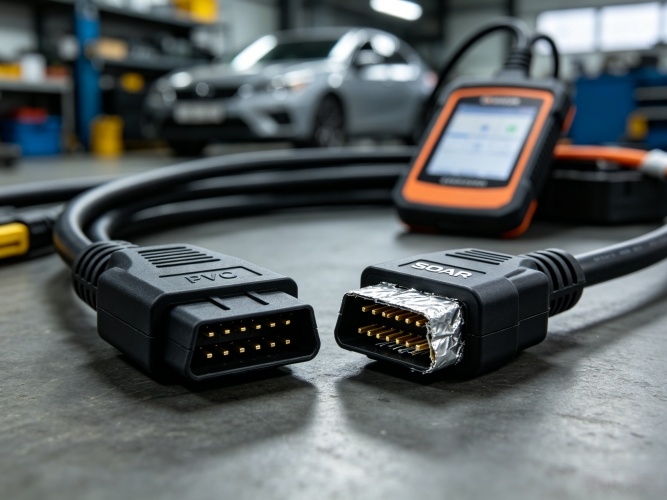
A standard OBD-II (J1962) cable is designed for occasional consumer use. In contrast, a custom-engineered solution is built for constant mating cycles and harsh electrical environments. Diagnostic applications require more than just a 16-pin connection; they require specific wire gauges (AWG), shielding to prevent Electromagnetic Interference (EMI), and specialized housing materials.
Customization allows engineers to define the pinout configuration—critical for proprietary diagnostic protocols that go beyond standard CAN bus requirements. Whether it is a Y-splitter for secondary telematics or a heavy-duty J1939 adapter for commercial vehicles, the internal architecture of the cable dictates the accuracy of the data stream.
The transition from a prototype to a market-ready diagnostic tool requires a cable assembly that can withstand the "real world" of automotive repair and industrial fleet operations.
Most failures in diagnostic cables occur at the strain relief point. SOAR utilizes advanced high-pressure overmolding techniques with materials like TPU (Thermoplastic Polyurethane) rather than standard PVC. TPU offers superior resistance to:
Modern vehicles utilize high-speed CAN (Controller Area Network) and Ethernet-based diagnostics (DoIP). Poorly shielded cables introduce "noise," leading to packet loss or communication timeouts. The SOAR Custom OBD Connector Cable incorporates twisted-pair wiring and aluminum-mylar shielding. This ensures that even in environments with high electrical noise—such as near ignition coils or high-voltage EV components—the data remains pristine.
The pins within the connector are often overlooked. Cheap connectors use thin plating that wears down after 50–100 cycles. Professional custom cables utilize thicker gold or nickel plating on high-conductivity copper alloys. This reduces contact resistance and ensures that low-voltage signals are transmitted without voltage drops, which is vital for ECU flashing and programming.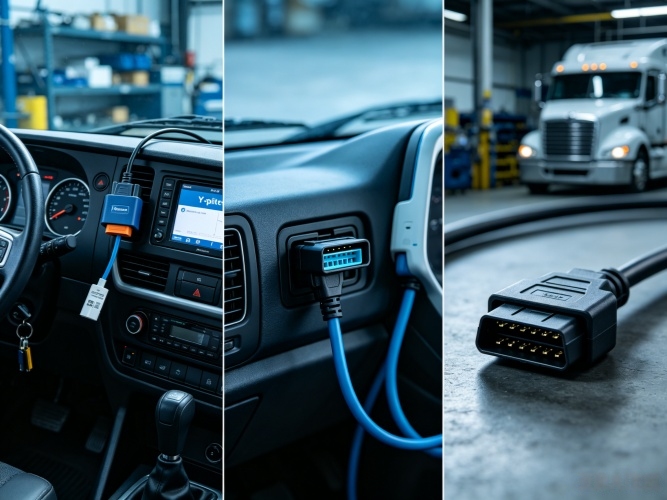
Comparison: Standard vs. SOAR Custom OBD Connector Cables
| Feature | Standard OBD Cable | SOAR Custom OBD Cable |
|---|---|---|
| Material | Standard PVC | TPU / Specialized Polymers |
| Mating Cycles | < 500 Cycles | > 5,000 Cycles |
| Shielding | Minimal/None | Braided or Foil Shielding (EMI/EMC) |
| Customization | Fixed Pinout | Fully Configurable (Y-Splitter, D-Sub, etc.) |
| Compliance | Basic J1962 | SAE J1962, ISO 15031, REACH/RoHS |
| Application | DIY/Consumer | OEM, Telematics, Industrial Fleet |
The versatility of the SOAR OBD connector collection allows it to bridge the gap between various hardware ecosystems.
For companies installing ELD (Electronic Logging Devices), space is often a constraint. Custom right-angle connectors or low-profile OBD cables allow for "stealth" installations that don't interfere with the driver's knees. Furthermore, Y-splitter configurations enable the vehicle owner to keep the OBD port "open" for service while the telematics device remains permanently connected.
Electric vehicles present unique EMI challenges due to high-voltage inverters. Custom cables for EVs often require specific shielding grades and orange-coded jackets for safety identification. By customizing the cable assembly, manufacturers can ensure compliance with emerging EV diagnostic standards.
While passenger cars use the standard 16-pin layout, the trucking industry relies on the 9-pin Deutsch connector (J1939). A custom SOAR solution can integrate both standards into a single harness, allowing a single diagnostic tool to interface with diverse fleets without multiple adapters.
In a B2B context, the "unit price" of a cable is only part of the equation. Total cost includes the warranty claims and technical support calls caused by cable failure.
When partnering with a specialist like SOAR, the manufacturing process follows a rigorous quality-controlled path:

Q1: Can I customize the pinout for a proprietary diagnostic tool?
Yes. Unlike standard cables, a custom SOAR OBD cable allows you to map any of the 16 pins to specific wires, enabling support for non-standard protocols or secondary power lines used in proprietary hardware.
Q2: What is the benefit of TPU over PVC for automotive cables?
TPU is more durable, offers better "memory" (it returns to its shape), and is highly resistant to grease and abrasion. It is the industry standard for professional diagnostic tools that see daily use in workshops.
Q3: Do these cables support DoIP (Diagnostics over IP)?
Absolutely. For DoIP applications, we use high-quality twisted pairs and specific shielding to ensure the cable meets the bandwidth requirements for automotive Ethernet diagnostics.
Q4: What is the typical lead time for a custom OBD cable project?
Prototyping usually takes 1–2 weeks, while mass production depends on the complexity of the tooling, typically ranging from 3 to 5 weeks.
Q5: Are these cables compliant with SAE J1962 standards?
Yes, all custom OBD connectors are designed to meet or exceed SAE J1962 and ISO 15031-3 physical layer standards to ensure perfect fitment with vehicle ports.


